This guide uses the FlyRod.com selection framework edited by Adam Riley.
These are starting points, not rules. If your largest common fly or normal wind is more demanding than the species suggests, choose for the fly and conditions.
| Common situation | Practical starting configuration |
|---|---|
| One general trout rod | 9', 5 wt, medium-fast, 4-piece |
| Small brushy trout streams | 7'6"–8'6", 3–4 wt |
| Bass / bigger streamers | 9', 6–7 wt |
| Steelhead / large rivers | 9'6"–10', 7–8 wt |
| Bonefish / inshore salt | 9', 8–9 wt, faster action |
| Dedicated Euro nymphing | 10'–11', usually 2–4 wt |
The quick-start answer
Most first-time buyers do not need to compare dozens of brands. They need to define the job. Start with the fish, the flies, the water and the conditions. Those four factors determine the useful range of rod weights and lengths. Your experience and casting preference then help refine action, while travel and storage determine how many sections the rod should have.
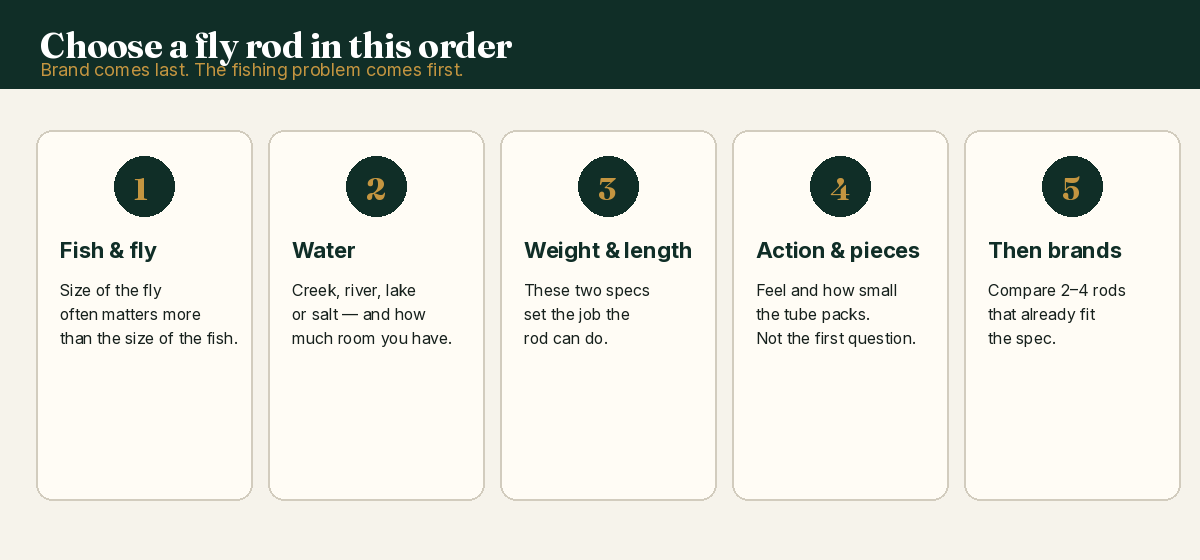
Choose in the right order
A fly rod is one part of a casting system. The rod must load with a matching line and move the flies you intend to use. That is why brand should come near the end of the decision—not the beginning.
- 01Define the fish and fly size
Fish strength matters, but fly size and air resistance often determine how much line mass you need.
- 02Define the water and casting space
Tight creeks favour compact rods. Open rivers and lakes reward reach. Wind and distance can justify more power.
- 03Select rod weight and length
These two specifications determine the broad job the rod can perform.
- 04Select action and piece count
Action shapes feel and timing. Piece count mainly affects portability and storage.
- 05Compare complete outfits
Budget for the rod, line, reel, backing and leaders—not the rod alone.
Choose the fly rod weight
Fly rod “weight” does not describe how heavy the rod feels in your hand. It is a line-system rating. A 5-weight rod is designed around a 5-weight fly line, while an 8-weight rod is designed around a heavier 8-weight line. Heavier lines carry larger flies, fight wind more effectively and help control stronger fish. Lighter lines make softer presentations and are more enjoyable with smaller fish.
Rod weight by common use
| Rod weight | Typical strengths | Common limitations | Frequent uses |
|---|---|---|---|
| 1–2 weight | Maximum delicacy and small-fish feel | Limited fly size, wind performance and fish control | Tiny creeks, panfish, very small trout |
| 3 weight | Light presentations with more usefulness than ultralight rods | Not ideal for bulky flies or sustained wind | Small streams, dry flies, light nymphing |
| 4 weight | Delicate trout work with useful versatility | Less authority with large streamers and heavy rigs | Trout, spring creeks, smaller rivers |
| 5 weightMost versatile | Balanced delicacy, line control and general freshwater capability | Not specialized for tiny creeks, giant flies or heavy saltwater | General trout, panfish, light bass |
| 6 weight | More power for wind, streamers and heavier rigs | Less delicate than a 4- or 5-weight | Large trout, bass, lakes, light steelhead |
| 7–8 weight | Large flies, stronger wind and more fish-fighting authority | Can overpower smaller fish and reduce delicacy | Bass, steelhead, salmon, pike, bonefish |
| 9–10 weight | Heavy flies, demanding saltwater and large predators | Heavier to cast and unnecessary for ordinary freshwater | Permit, pike, muskie, salmon, smaller tarpon |
| 11–12+ weight | Maximum lifting power and control | Specialized, tiring and expensive as a complete outfit | Large tarpon and powerful saltwater species |
Choose for the fly, not only the fish
A common mistake is matching rod weight only to fish size. A modest fish may require a heavier rod if you must cast a large, weighted or wind-resistant fly. Conversely, a larger trout eating tiny dry flies in calm water may be best approached with a lighter system.
You fish small water, use small flies, value delicate presentations and rarely face strong wind.
You cast streamers, weighted rigs or poppers, face wind, need distance or target strong fish around cover.
Continue learning: Read the complete fly rod weight guide, compare 5-weight vs. 6-weight, or browse every rod-weight guide.
Choose the rod length
Rod length affects reach, line control, casting clearance and leverage. For ordinary single-hand freshwater fishing, nine feet is the benchmark because it works well across many situations without becoming cumbersome.
| Fishing environment | Useful starting length | Why |
|---|---|---|
| Tight, brushy creek | 7′–8′6″ | Less rod to move under branches and around vegetation |
| General river trout | 9′ | Balanced casting, mending, reach and portability |
| Lake or stillwater | 9′–10′ | Additional reach can improve line pickup and control |
| Euro nymphing | 10′–11′ | Extra reach helps maintain contact and manage drift |
| Large river, two-handed casting | 11′–15′ | Designed for Spey or switch techniques and long line control |
Shorter is not automatically easier
A short rod fits confined water, but it does not necessarily make casting easier. A beginner on open water may find a nine-foot rod easier because the common length provides useful leverage and line control. Choose shorter because the environment demands it—not because the rod looks simpler.
Longer is not automatically better
Extra length increases reach, but it also increases leverage against your casting hand and can feel less precise in tight spaces. Specialized 10- and 11-foot rods are excellent when the technique benefits from them. They are not universal replacements for a nine-foot rod.
Continue learning: See the full fly rod length guide and compare 9-foot vs. 10-foot rods.
Choose the rod action
Action describes where a rod bends under load and how quickly it returns. It strongly influences timing and feel. It does not, by itself, tell you whether a rod is “good.” Two rods carrying the same action label can still feel different because manufacturers use the terms broadly.
Deeper bend and clear feedback
Often pleasant at short and moderate distances. It can help anglers feel the rod load, but may offer less line speed in strong wind or with bulky flies.
Best fit: relaxed casting, small streams, dry flies, anglers who value feel.The broadest compromise
Combines useful feedback with enough recovery and power for varied freshwater situations. This is usually the safest place for a beginner to start.
Best fit: general trout, learning, all-purpose freshwater use.Higher line speed and power
Helpful for wind, distance and heavier flies. It may demand more precise timing and can feel less communicative at short range.
Best fit: saltwater, streamers, wind, experienced casters who prefer a quick tempo.Continue learning: Read fly rod action explained and compare fast vs. medium action.
Choose how many pieces
Modern multi-piece rods are the normal choice for most anglers. Four-piece rods fit easily in vehicles, luggage and closets while retaining the performance needed for nearly every use. Two-piece rods can be quick to assemble and appeal to anglers who store them rigged, but they are harder to transport. Six-piece travel rods pack smaller and make sense for frequent air travel or backcountry trips.
Fast assembly and fewer ferrules, but awkward in small vehicles and during travel.
The modern standard for portability, storage and broad availability.
Excellent packability with more assembly and additional ferrules to maintain.
Rare outside specialized applications because transportation is difficult.
For most buyers, choose four pieces unless you have a specific reason not to. Read the four-piece vs. two-piece comparison for more detail.
Choose the rod material
Graphite dominates modern fly rods because it can be engineered across a wide range of weights and actions. Fiberglass and bamboo remain valuable, but they are better treated as deliberate preferences rather than automatic upgrades.
| Material | Character | Best reasons to choose it | Trade-offs |
|---|---|---|---|
| Graphite | Light, responsive and available in nearly every action | Versatility, low swing weight, broad model choice | Feel varies widely; premium pricing can rise sharply |
| Fiberglass | Deeper flex and slower, playful feel | Small streams, short casts, anglers who enjoy feedback | Often heavier and less efficient at distance |
| Bamboo | Traditional, smooth and highly tactile | Craftsmanship, heritage and deliberate casting | Cost, care, weight and limited practicality for many beginners |
A first rod should usually be graphite because it offers the easiest path to a suitable specification and budget. Explore the complete graphite vs. fiberglass vs. bamboo guide.
Set a budget for the complete outfit
The rod is not the entire purchase. You also need a properly matched fly line, reel, backing, leaders and basic accessories. The line directly affects how the rod loads and casts, so protecting the line budget is often more important than moving one tier higher on the rod.
The primary tool, but not the whole system.
A high-impact component that should match the rod and use.
Freshwater reels can be simple; saltwater drag and corrosion resistance cost more.
Reserve enough to fish immediately rather than owning an incomplete outfit.
What higher prices can buy
Pay more when you can identify the benefit: lower swing weight, more refined recovery, better component quality, a preferred action profile, stronger corrosion resistance, domestic manufacturing, a better warranty or more reliable support. Do not pay more simply because a premium rod is described with vague claims about “technology” or “performance.”
Use the how much to spend on a fly rod guide for a more complete budget framework.
Build a shortlist and test intelligently
Once you know the specification, compare two to four rods that actually fit it. A useful shortlist is narrow enough to evaluate and broad enough to reveal meaningful differences.
Compare these factors
How to test-cast a rod
When possible, cast the rod with the line you expect to use. Begin at realistic fishing distances rather than immediately trying to cast as far as possible. Make short casts, moderate casts, roll casts and a few presentations with the type of leader and fly you expect to fish. Notice whether the rod communicates the load, tracks comfortably and recovers without requiring you to change your natural tempo.
Do not let one long cast decide the purchase. Most fishing is not a distance competition. Accuracy, line control, fatigue and confidence matter more than the single longest cast you can produce in a parking lot.
Common starting configurations
These setups are practical starting points. Local conditions, fly size and personal casting style can justify moving up or down.
A broad freshwater starting point for rivers, lakes, dry flies, nymphs and moderate streamers.
Explore 5-weight rods →Compact and enjoyable for short presentations, small flies and close-range fishing.
Explore small-stream fishing →More line mass for poppers, weighted streamers, wind and stronger fish around cover.
Explore bass rods →Extra length for contact, drift control and tight-line presentations.
Explore Euro nymphing →A common starting point for bonefish and other light saltwater situations.
Explore saltwater rods →Designed to move bulky flies and provide leverage around large, powerful fish.
Explore pike rods →Common fly rod buying mistakes
Buying by brand before defining the job
A respected logo cannot make the wrong weight or length suitable for your fishing.
Matching only to fish size
Fly size, wind, distance, current and cover can matter as much as the fish.
Assuming faster means better
Fast rods are useful tools, not a universal quality ranking. Choose the action that fits your timing and conditions.
Spending the entire budget on the rod
A weak or mismatched line can prevent an expensive rod from performing as intended.
Buying too specialized too soon
Your first rod should solve your most common fishing problem. Specialty rods make sense after repeated limitations become obvious.
Ignoring warranty logistics
A warranty is only useful when the process, cost, turnaround and replacement-section policy fit your needs.
See the expanded guide to common beginner fly rod mistakes.
Three outfits, written as real starting points
Prices move. These are configuration examples from September 2026, not a ranked shop list. Confirm line weight and current street price before you buy.
First trout rod
9′ · 5wt · medium-fast · 4-piece
Adult learning mixed dries, nymphs and the odd streamer on a Midwestern or Western river. Pair with a true 5-weight floating line. Do not spend the whole budget on the blank and cheap out on the line.
Brushy creek
7′6″–8′6″ · 3–4wt · medium
Small water, small flies, trees in the backcast. A 9-foot 5-weight is legal here. It is also clumsy. Shorter and lighter is the point.
Wind and streamers
9′ · 6wt · medium-fast to fast
Lakes, bigger trout flies, or a river that lives in the wind. The extra line mass is for the fly and the weather, not for showing off distance in a parking lot.
If those three sentences already match your season, you can stop reading brand catalogs. Use the rod finder only to confirm the spec, then compare two or three rods that actually fit it.
Frequently asked questions
What fly rod should a beginner buy?
For general freshwater trout fishing, begin with a 9-foot, 5-weight, medium-fast, four-piece graphite rod. Change that recommendation when your primary fishing is small creeks, bass, steelhead, salmon, pike, saltwater or a specialized technique such as Euro nymphing.
Is a 5-weight or 6-weight better?
A 5-weight generally offers more delicacy and is the classic all-purpose trout choice. A 6-weight adds power for wind, larger flies, heavier rigs, lake fishing and somewhat larger fish. Compare the two in our 5-weight vs. 6-weight guide.
Can one fly rod do everything?
No single rod is ideal for every species and technique. A versatile rod can cover a useful range, but a rod suited to tiny dry flies cannot also be ideal for giant pike flies or large tarpon. Start with the least specialized rod that comfortably handles your most common fishing.
Should a beginner buy a fly rod combo?
A well-designed combo can simplify line and reel matching and may offer good value. Confirm that the included line is appropriate and that the rod specification fits your actual fishing. Convenience does not compensate for the wrong weight or length.
Does fly rod brand matter?
Brand matters less than specification, fit, quality control, warranty and support. Define weight, length, action and budget first. Then compare brands offering suitable rods within that range.
Should I overline my fly rod?
Using a line heavier than the rod’s nominal rating can help some rods load at short distances, but it changes the system and may reduce performance elsewhere. Start with the manufacturer’s intended line profile unless you understand the specific reason for changing it.
How important is the reel?
For ordinary freshwater trout, the reel mainly stores line and provides balance. For large freshwater and saltwater species, drag quality, capacity, durability and corrosion resistance become much more important.
How long should a fly rod last?
A well-maintained rod can last for many years. Avoid striking the blank with weighted flies, inspect and clean ferrules, rinse saltwater equipment and store the rod dry in its case. Accidental impact often causes more failures than ordinary casting.
This guide provides an educational decision framework, not a universal prescription. Local conditions, fly size, casting tempo and personal preference may justify a different setup. Product specifications and availability can change; confirm current details with the manufacturer or retailer.