Quick answer
Fast-action rods concentrate more flex toward the tip and generally recover quickly. They can be useful when you need line speed, wind reserve or control over larger flies. Medium and medium-fast rods bend deeper and often make it easier to feel the rod load at ordinary fishing distance. Slow-action rods flex deepest and reward a more deliberate casting tempo.
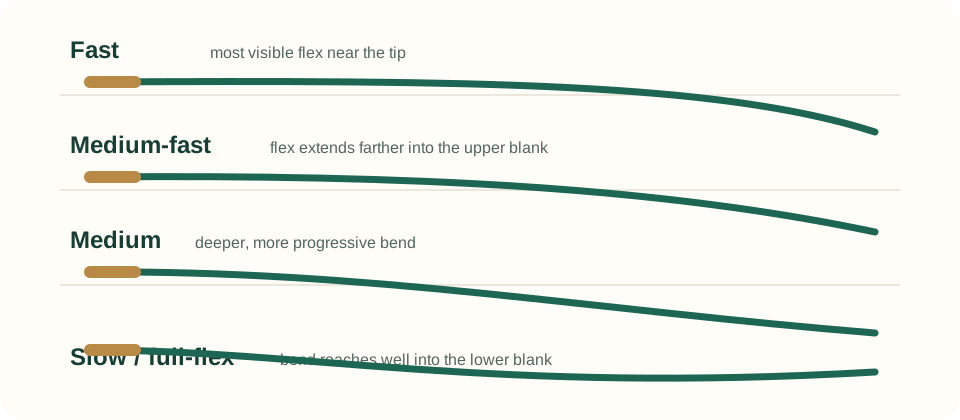
What the labels usually mean
| Action | Typical feel | Often useful for | Trade-off |
|---|---|---|---|
| Fast | Most flex higher in the blank; quick recovery | Wind, longer casts, larger flies, carrying line | Can feel less communicative at very short range |
| Medium-fast | Progressive bend with useful reserve | General trout, mixed techniques, all-around use | Not as specialized at either extreme |
| Medium | Deeper loading and a more obvious casting rhythm | Dry flies, shorter-to-medium casts, anglers who like feel | Less reserve for bulky flies or hard wind |
| Slow | Deep flex through much of the blank | Close presentations, small water, traditional glass/bamboo feel | Requires timing; not ideal for every wind or payload |
What action changes in your hand
At 20 to 40 feet, a more moderate rod often tells you clearly when the line has loaded the blank. A faster rod can feel crisper and may tolerate a quicker stroke, but it still needs enough line mass to bend. If a fast rod feels like a broomstick at the distances you actually fish, the problem may be fit rather than skill.
Recovery matters too. After the rod unloads, extra tip bounce can widen loops and reduce accuracy. Faster recovery can help, but recovery and labeled action are not the same thing; blank design, materials and taper all contribute.
Choose action from the fishing you do most
- Small dries and spring creeks: medium to medium-fast often gives useful feel and presentation.
- General trout: medium-fast is a practical starting point because it spans dries, nymphs and modest streamers.
- Big streamers or wind: faster designs can provide useful reserve when the line and fly demand it.
- Small streams: a rod that loads with little line outside the tip matters more than a fashionable action label.
- Saltwater: quick recovery and wind performance matter, but the rod must still load predictably at realistic casting distance.
Common mistakes
- Buying “fast” because it sounds more advanced.
- Testing rods only with 60-foot lawn casts when most fishing happens inside 40 feet.
- Ignoring fly line taper; a different line can materially change how quickly a rod loads.
- Assuming action determines power. Rod weight, taper and intended use matter separately.
What changes the answer?
| If this is your normal fishing | Lean toward | Why |
|---|---|---|
| Small dries, short-to-medium casts, light tippet | Medium to medium-fast | Easier loading feedback and a more progressive feel can help presentation. |
| Mixed trout with one rod | Medium-fast | Usually the broadest compromise across dries, nymphs and modest streamers. |
| Wind, larger flies, longer carries | Medium-fast to fast | Quicker recovery and reserve can help when the line system and fly demand more. |
| Tight small water | Whichever rod loads cleanly with little line out | Short-range loading matters more than the marketing label. |
Where the labels stop being precise
There is no universal industry scale that makes every manufacturer's “fast” or “medium-fast” identical. Treat the label as a starting description, then compare the actual taper, line pairing and feel at fishing distance.
For a real-world example of how manufacturers describe action differently within a lineup, compare the current Winston PURE 2 descriptions with faster-action families from other makers. Manufacturer language is useful context, but it is not a cross-brand measurement standard.
Bottom line
Choose the action that makes your normal casts, fly sizes and presentations easier. Do not buy a faster rod simply because “fast” sounds more advanced.