Starting setup
| Rod weight | 5-weight |
|---|---|
| Length | 9-foot |
| Action | medium-fast |
Trout fishing spans tiny brushy creeks, broad western rivers, tailwaters and stillwaters, so there is no single perfect trout rod. A 9-foot 5-weight remains the most useful one-rod baseline because it can present dry flies, cast common indicator rigs and handle moderate streamers without becoming overly specialized.
Use that baseline as a starting point, then move lighter or heavier only when the fishing situation gives you a specific reason.
Choose by fishing situation
| Situation | Useful weight | Typical length | Action direction |
|---|---|---|---|
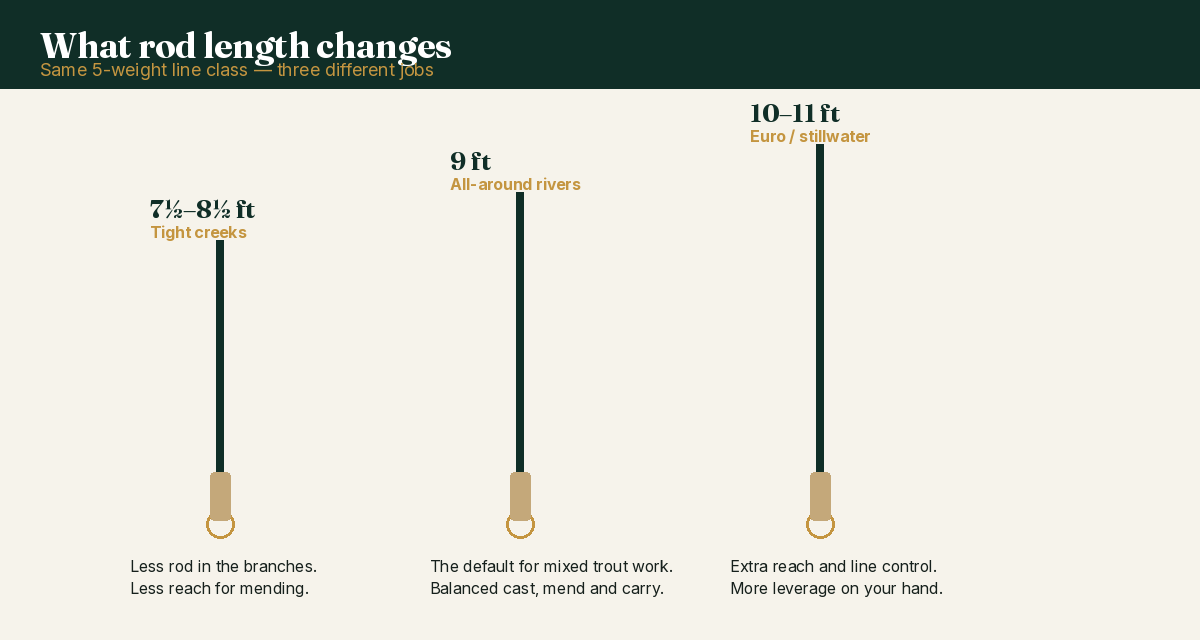
| Small streams / light dries | 3–4 wt | 7–8½ ft | Moderate to medium-fast |
| General river trout | 5 wt | 9 ft | Medium-fast |
| Euro nymphing | 3–4 wt | 10–11 ft | Technique-specific / responsive |
| Larger streamers or windy water | 6 wt | 9 ft | Medium-fast to fast |
| Stillwater / longer leaders | 5–6 wt | 9–10 ft | Medium-fast |
The ranges above describe practical starting points, not hard rules. Line design, leader construction, casting style and local conditions can shift the best choice.
Fly size and presentation
Small dry flies and light nymphs reward a rod that loads easily and protects fine tippet. Weighted nymph rigs, strike indicators and articulated streamers increase air resistance and payload, which is where a 5- or 6-weight becomes easier to cast accurately.
A useful rule is to size the rod for the hardest common casting job rather than the easiest cast you will make all day.
Water, wind and fish control
On small wooded streams, rod length can matter more than raw casting distance: shorter rods reduce tip collisions and improve maneuverability. On broad rivers, extra reach helps with line control and mending. Wind and heavier flies push the decision toward more line mass and a faster recovery.
Rod choice also affects how efficiently you can control line and land fish. The lightest possible rod is not automatically the most sporting choice if it compromises control or extends fight time.
Common mistakes
- Buying a 6-weight for ordinary dry-fly trout because “more power is safer,” then sacrificing touch and light-tippet protection.
- Choosing an extra-short creek rod as the only trout rod when most fishing is on open rivers.
- Treating “5-weight” as a complete specification without considering length and action.
- Using a very fast rod that does not match the caster’s timing simply because it is marketed as higher performance.
How the rest of the setup changes
A trout rod should be paired with a line and leader that reflect the same job. A presentation-oriented 4-weight may work best with a line that loads comfortably at normal river distances and a long leader for small dries, while a 6-weight streamer setup may need a more aggressive taper and shorter, stronger leader to turn over bulk. The point is consistency: the rod, line and leader should all solve the same casting problem.
If one trout rod must cover everything, keep the system neutral rather than optimizing it around an occasional extreme. A versatile 5-weight line, adaptable leader setup and moderate-to-medium-fast rod will usually cover more real fishing than a highly specialized combination.
Final decision rule
For trout, start with the configuration that fits your most common water and flies, not the most extreme fish you might encounter once a year. If two choices are close, favor the setup that makes your everyday casting and line control easier.
These are practical selection ranges rather than universal prescriptions. Local guides, fish size, weather and the exact line system can justify moving outside them.