Independent fly-rod education for anglers at every level.How we evaluate gear
Rod weight guide

5-Weight Fly Rod Guide

A 5-weight is the middle of the freshwater fly-rod spectrum: versatile enough for most trout fishing, but not a universal answer. This guide shows where it fits and where to move lighter or heavier.

How to use this guide: Start with the fishing problem, then choose the rod specification that solves it. Rod labels are useful starting points, not guarantees—two rods with the same stated weight, length and action can still feel different.

Quick answer

A 9-foot 5-weight is the classic general-purpose trout setup because it can handle dry flies, common nymph rigs and modest streamers without becoming excessively heavy. It is not the best rod for every trout situation, and it is not automatically the best first rod for bass, saltwater or brushy creeks.

Choose a 5-weight when most of your fishing sits in the middle. If the flies and wind are usually light, consider a 4-weight. If hoppers, streamers, bigger water or wind are routine, consider a 6-weight.

What a 5-weight handles well

Use5-weight fitComment
Trout dry fliesExcellent general fitEnough line mass for range without giving up too much presentation.
Standard nymph rigsVery goodWorks well until rigs become especially heavy or wind-resistant.
Small / medium streamersGoodFine for modest streamers; large articulated flies point toward a 6–7 wt.
PanfishWorks, but heavier than necessaryA 2–4 wt can be more enjoyable.
BassPossible with small fliesMost bass-focused anglers gain useful turnover power from a 6–8 wt.

Why 9 feet is the default

Nine feet is long enough for useful line control and mending on ordinary rivers while remaining manageable for general casting. Go shorter when brush and tight quarters dominate. Go longer when reach and line control are central to the technique.

What action should a 5-weight have?

Medium-fast is a practical middle ground for many anglers. Moderate actions provide clearer bend and can feel pleasant at shorter ranges. Faster rods can help generate line speed in wind or longer casts, but a fast label is not automatically easier or better.

When a 6-weight is the better choice

  • You fish hoppers, streamers or bulky indicator rigs often.
  • Wind is a regular part of the day.
  • You split time between trout and bass.
  • You fish lakes or larger water where more line pickup and turnover power matter.

Compare 5-weight vs 6-weight

Match the line to the rod and use

Start with the manufacturer's stated line rating. Specialty lines can have different head weights and tapers even when the box says “5 wt,” so choose the line for the casting job rather than assuming every 5-weight line will make a rod feel identical.

Is a 5-weight a good first rod?

Yes—if general trout is the main goal. If you already know your fishing will be bass, saltwater, Euro nymphing or very small creeks, start with the tool for that job instead of buying a 5-weight because it is the default.
What a 5-weight actually does on the water

A 5-weight is popular because it sits in the middle, not because it is magic. It will present a size-12 dry, turn over a modest nymph rig, and throw a small streamer if you are not fighting a gale. That is a lot of Minnesota, Wisconsin, and general trout water. It is not “the trout rod” for every creek and every lake.

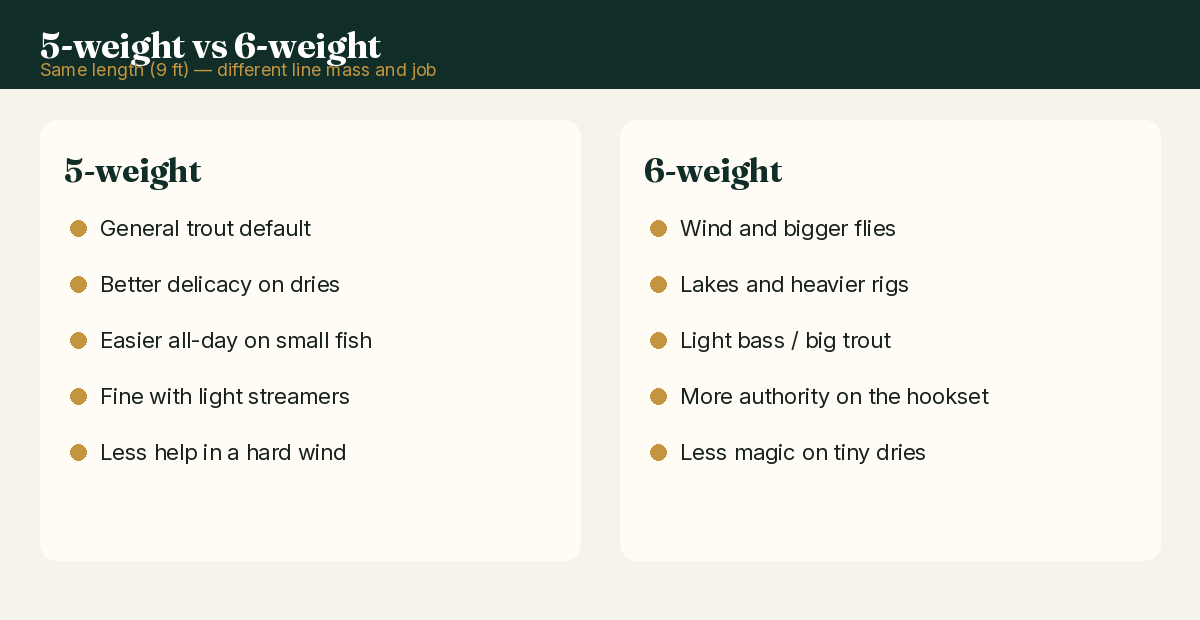
Side-by-side comparison of a 5-weight and 6-weight fly rod
If most days include wind or a bigger fly, look at the 6-weight column.

Keep the 5-weight when your average fly is not bulky, the river is not a wind tunnel, and you want one rod for mixed trout work.

Step to a 6-weight when you keep wishing the line had more mass — hoppers in the wind, sinking tips, or fish that live around timber. Read the full 5-weight vs 6-weight page before you own both.

Frequently asked questions

Is a 5-weight a good first fly rod?

Yes, for many freshwater beginners targeting trout on rivers and lakes. A 9-foot 5-weight with a medium-fast action covers common flies and ordinary wind. It is a starting point, not a rule for small creeks, heavy streamers or saltwater.

When should I buy a 4-weight instead?

Move to a 4-weight when you fish small water, small dry flies and value a softer presentation more than wind performance or bulky flies.

When should I buy a 6-weight instead?

Move to a 6-weight when wind, larger streamers, lakes, light bass or extra line mass show up in most of your days. See the 5-weight vs 6-weight comparison.

What length is typical for a 5-weight?

Nine feet is the common all-purpose length. Shorter 5-weights exist for tight water; longer 5-weights show up in some stillwater and nymphing setups.