How to use this guide: Start with the fishing problem, then choose the rod specification that solves it. Rod labels are useful starting points, not guarantees—two rods with the same stated weight, length and action can still feel different.
The rod from tip to reel seat
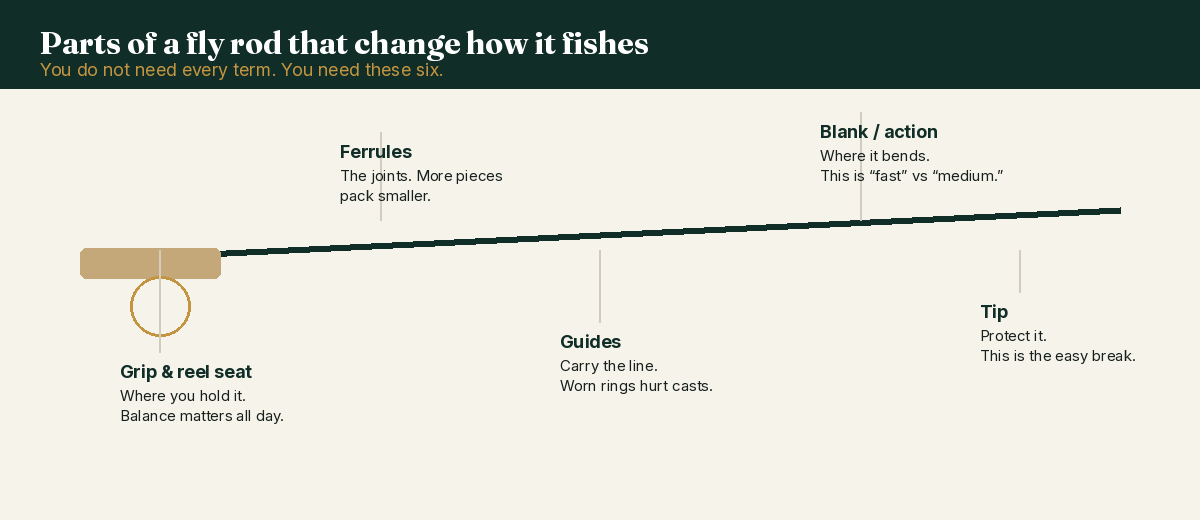
The parts that actually matter
| Part | What it does | What to check |
|---|---|---|
| Tip / tip-top | Guides the line at the end of the rod and contributes to fine feel. | Straight, undamaged, smooth insert/frame. |
| Blank | The structural tube that bends and recovers during casting and fighting fish. | Correct weight/action for your use; no cracks or impact damage. |
| Ferrules | Join multi-piece rod sections. | Sections seat securely, align properly and do not loosen repeatedly. |
| Snake / running guides | Keep fly line tracking along the blank. | No grooves, bends or rough spots that can damage line. |
| Stripping guides | Larger lower guides that manage line entering and leaving the rod. | Frames and inserts are intact, especially on heavier rods. |
| Grip | Where the caster controls the rod. | Shape and diameter feel comfortable for your hand and rod class. |
| Reel seat | Secures the reel to the rod. | Reel fits firmly without movement; hardware tightens smoothly. |
| Fighting butt | Extra support on many heavier rods. | Useful for leverage; not necessary on most light trout rods. |
Ferrules deserve more attention than decoration
On a multi-piece rod, ferrules are functional joints. Assemble the sections fully, align the guides, and check them during a day of fishing if the rod has a habit of working loose. Grit on a ferrule can damage the fit; forcing stuck sections apart can damage the rod.
How to inspect guides in 30 seconds
Run a cotton swab or soft cloth through and around a suspect guide. If fibers catch, the guide may have a burr or groove capable of damaging fly line. This matters more than whether the guide finish looks expensive.
Grip and reel seat: comfort before cosmetics
Cork grade, exotic wood and machined hardware can make a rod look premium, but they do not rescue a rod that is wrong for your fishing. The grip should let you hold the rod without squeezing hard, and the reel seat should keep the reel secure throughout the day.
If you are checking a used fly rod
- Look closely at the blank around ferrules and guides for cracks or impact marks.
- Check every guide for grooves and loose wraps.
- Assemble all sections and confirm they are the correct matching pieces.
- Mount a reel and make sure the seat holds it firmly.
- Ask whether replacement sections are still available before paying a premium for an older model.